
Corporate succession.
Handing over a life’s work requires more than a set of contracts.
We structure successions so that the business, the family, and its values are sustained.
Making the right use of the right timing .
Internal family transfer, sale to management, or disposal to an external investor—each succession follows its own logic. We analyse the starting position, family circumstances, and tax framework and develop a robust structure from this.
Our standard: legally sound solutions that allow the business to continue and align the economic interests of all parties involved—from the transferor, to the family, to the next owner.
Service Spectrum
What we handle for you.
01
Management Buy-Out / Buy-In
Structuring MBOs and MBIs, financing, participation models, and earn-out arrangements.
02
Family succession
Structuring, shareholders’ agreements, exit arrangements for sustainable partnerships.
03
Sale to external acquirers
Preparation, vendor due diligence, bidding process, negotiation, and closing.
04
Holding structures & foundations
Family holding company, family foundation, and double-foundation structures to safeguard your life’s work for the long term.
05
Inheritance and tax law
Integration with inheritance law and tax optimisation—together with your tax advisers.
06
Governance & advisory board
Advisory board structures, family governance, and conflict prevention between shareholder branches.
Who we work for
Clients seeking clarity.
- Owner-managed family businesses
- Transferring shareholders
- Next generation
- Family offices
- Managing directors (MBO / MBI)
- Strategic and financial investors
- Foundations and advisory boards
- Co-shareholders & co-investors
Our Approach
How we work.
Forward-looking
A successful succession begins long before closing. We create the legal and structural prerequisites for a smooth transition.
Value-driven
We approach succession from the perspective of enterprise value. Structure, governance, and negotiating position determine the success of the transaction.
Personal
Every succession is as individual as the business behind it. We support entrepreneurs personally, discreetly, and with dedicated points of contact.
Future-proof
Our focus does not end with the signature. We design solutions that secure the continued existence of the business and a successful transition to the next generation of owners.
Process
From the first conversation to
closing—and beyond.
I
Establishing the status quo
Analysis of the starting position, family circumstances, values, and key financial figures.
II
Structuring
Development of the legal and tax succession structure—coordinated with advisers.
III
Preparation
Articles of association, vendor due diligence, family governance, communication.
IV
Implementation
Negotiation with acquirers, heirs, or successors; transaction documentation and notary appointment.
V
Handover
Support during the transition, advisory board work, and post-closing matters.
Insights
Clarity in a few minutes.
Structuring successions so that the business, the family, and its values are sustained.













FAQ
Frequently asked questions about corporate succession.
Do you have a specific question about your transaction? We will respond within 24 hours.
When is the right time to start a company sale?
Ideally two to three years before the planned exit—this leaves sufficient time to prepare figures, structures, and contracts optimally.
However, a sale is also possible at short notice (“ad hoc”), for example for personal or economic reasons. Good results can still be achieved, though often with slightly less room for structuring and more compromises on structure or timeline.
How can I tell whether my company is ready for sale?
Stable revenue, functioning processes, and an independent management team are good prerequisites. We help identify potential stumbling blocks at an early stage.
What is the difference between a sale to family, management, or investors?
An external sale usually focuses on achieving the best price, while internal successions prioritise continuity and preserving values. The legal and tax consequences differ—we show what best fits your objectives.
How can I prepare my company for a sale?
We review and harmonise your key contracts—such as shareholder, employment, lease, and customer agreements—so that, from a buyer’s perspective, they are consistent, up to date, and legally sound.
What if I do not yet have a specific buyer?
No problem—specialised M&A advisers support the buyer search, while we prepare the legal structure and documentation in parallel.
How can I structure the sale for tax purposes?
Together with tax advisers, we review possible structures—such as holding models, gifting variants, or asset transfers—to optimise the proceeds for tax purposes.
What does it mean if my company is part of a holding structure?
Many entrepreneurs hold their operating company via a holding company. This can offer tax advantages—especially on a sale. What matters is how profits and proceeds flow between the companies. We review whether your structure is optimally set up for the planned sale or should be adjusted.
Do I need to change the corporate structure before the sale?
Sometimes this can be advisable—for example, to separate non-operating assets or to simplify the shareholding structure. We assess this on a case-by-case basis and support implementation.
How are real estate or hidden reserves treated?
Whether a property remains in the company, is sold separately, or is leased affects the purchase price and the tax burden. We help find the solution that best fits your commercial and tax objectives—together with your tax advisers.
How can I involve my family in the sale or succession?
Through clear contractual arrangements, gifting models, or advisory board solutions—legally robust, tax-efficient, and designed to minimise conflict.
What options do I have if the family does not take over?
Sale to management (MBO), to external managers (MBI), to strategic or financial investors, as well as foundation solutions. We review all options with an open outcome.
How is the company value determined?
Using recognised valuation methods (income approach, DCF, multiples). We coordinate with valuers and ensure the results are legally robust.
What does succession advice cost?
As a rule, we agree a tailored fee model—fixed fee for the structuring phase, hourly rates, or flat fees for implementation.
How are compulsory portions and waivers of inheritance handled?
Through notarised waivers of compulsory portions, settlement arrangements and, where appropriate, life insurance—embedded in holistic family planning.
What happens to the company after the handover?
If desired, we continue to support you beyond the handover—for example, on advisory boards or during the post-closing phase.
Ready for the next
step?
We will discuss your succession confidentially and without obligation—personally with the lead partner.
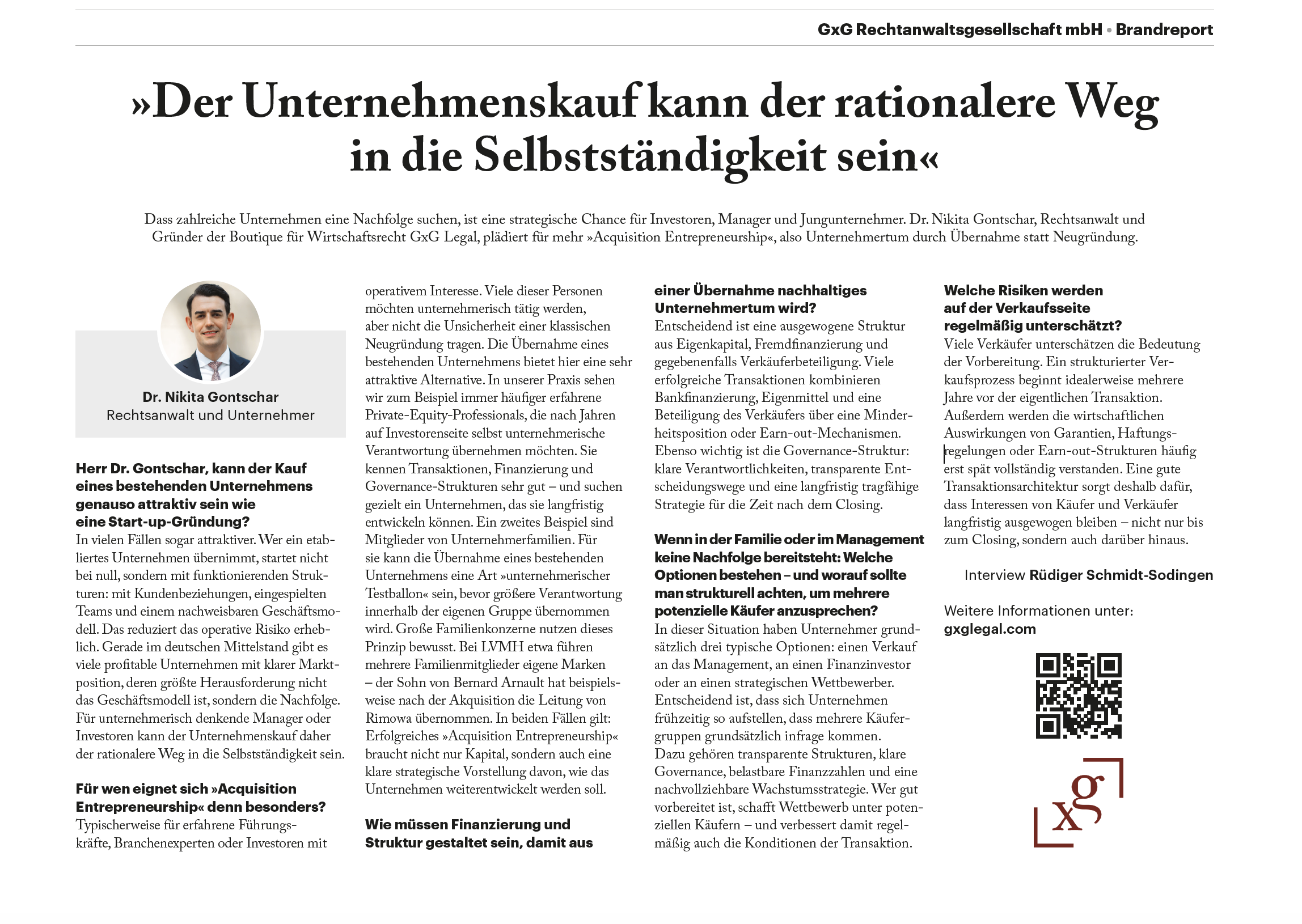
Interview in special supplement on M&A and succession in Handelsblatt dated March 25, 2026
In the interview, Dr. Nikita Gontschar explains why acquiring an established company is, in many cases, the more rational path to self-employment.