

Mergers & Acquisitions.
Strategic transaction advice for mid-sized companies, investors and corporate subsidiaries—with deal logic, clear communication and a focus on results.
Classification
Decisions with long-term impact.
Whether buying or selling a company—transactions require structure, speed, and clear priorities. As M&A attorneys in Frankfurt, we support entrepreneurs, shareholders, and investors in company sales, the sale of a GmbH, and corporate acquisitions—from preparation through due diligence to negotiation and execution of the SPA.
Our focus is on risk-oriented structuring, clear negotiation leadership, and legally secure solutions that are economically viable.
Service Spectrum
What we handle for you.
01
Company Acquisitions & Sales
Share and asset deals, purchase price structuring, earn-out, due diligence, negotiation of SPAs.
02
Joint Ventures & Minority Interests
Structuring, shareholders’ agreements, exit arrangements for sustainable partnerships.
03
Restructurings & Reorganizations
Mergers, spin-offs, conversions, and group reorganizations.
04
Regulatory Transaction Matters
Merger control, foreign trade approvals, and sector-specific procedures at national and EU level.
05
Financing Advisory & Covenants
Transaction financing, security structure, covenants, post-closing adjustments.
06
Corporate Governance & Liability
Board liability, executive compensation, and management of potential compliance risks.
Who we work for
Clients seeking clarity.
- Seller and buyer side
- Equity and debt investors
- Private Equity & Portfolio Companies
- Medium-sized enterprises
- Shareholders & Family Offices
- subsidiaries of corporate groups
- Consortia (club deals)
- Managing directors (MBO / MBI)
Our Approach
How we bring transactions to completion.
Experienced
From numerous national and cross-border transactions, we know what matters at every stage of a deal.
Strategic
We always keep the overall picture in view. Every negotiation step serves the economic success of the transaction.
Forward-looking
We identify critical issues early, prioritize the essential risks, and create solutions before they become deal-breakers.
Holistic
M&A does not end with the company acquisition. We consider corporate law, financing, taxes, and regulatory issues from the outset.
Process
From the first conversation to
closing.
I
Preparation
Strategy, M&A readiness, vendor due diligence.
II
Approach
Structured bidding process or bilateral negotiation.
III
Due Diligence
Legal, tax, financial, regulatory.
IV
Negotiation
Shareholders' agreements, SPA, warranties.
V
Closing & Integration
Execution, post-closing, implementation.
Insights
Clarity in a few minutes.
Strategic transaction advisory services for mid-sized companies, investors, and corporate subsidiaries.






FAQ
Frequently asked questions about M&A.
Do you have a specific question about your transaction? We will respond within 24 hours.
What does M&A mean and why is it important for mid-sized companies?
M&A refers to company acquisitions, sales, or mergers in which ownership structures are changed—a strategic path to growth, market share expansion, or succession solutions.
What are typical M&A transactions in the mid-market?
These include share deals, asset deals, management buy-outs/buy-ins, and strategic minority interests.
How does an M&A process in the mid-market generally proceed?
An M&A process comprises strategy, preparation (M&A readiness), target search, due diligence, contract negotiation, closing, and integration.
What is M&A readiness and why is it crucial?
M&A readiness describes how well a company is prepared legally, financially, and organizationally for a deal. Good preparation increases the chances of a successful completion.
What risks should I be aware of as a mid-sized entrepreneur in the M&A process?
Typical risks are incorrect company valuation, legal or tax pitfalls, lack of integration, or unknown liabilities.
What is the difference between a share deal and an asset deal?
In a share deal, company shares are transferred; in an asset deal, only selected assets and liabilities.
How do you prepare a legally secure due diligence?
A due diligence should cover all relevant legal, tax, financial, and operational areas in order to identify risks early.
What is the significance of company valuation in the mid-market?
The valuation determines the economic value of the company and is crucial for purchase price negotiations and fair deal structures.
What are earn-out clauses and when are they used?
Earn-out clauses link parts of the purchase price to future performance of the company or management—frequently used when forecasts are uncertain.
What are the special features of international M&A transactions?
International deals involve additional legal, tax, and regulatory aspects that go beyond the national level.
How does merger control affect mid-sized transactions?
For certain size criteria, transactions must be notified to and approved by national or EU antitrust authorities.
What role does integration play after closing?
Integration is crucial to realize synergies, adapt organizational processes, and align the cultural aspects of the companies.
How do I find potential buyers or investors for my company?
Strategic buyers, financial investors (e.g., private equity), or management teams can be identified through networks, investment banks, and specialized advisors.
What does M&A advisory typically cost for mid-sized deals?
Costs vary greatly depending on complexity and scope of services—from project-based fees to success fees. An individual cost estimate is part of the initial consultation.
Why is legal support in the M&A process advisable?
Legal expertise protects against risks, ensures fair contractual terms, and navigates safely through regulatory requirements.
How long does a typical M&A process in the mid-market take?
Mid-sized transactions can take from several months to over a year, depending on scope, complexity, and due diligence.
What strategic objectives can a mid-sized company achieve through M&A?
Objectives include, for example, market expansion, strengthening the product portfolio, or succession planning.
How can I improve my negotiating position as a seller?
Through solid preparation, clear financial and legal data, transparent communication, and professional advisory.
What role do tax aspects play in M&A?
Tax structuring can significantly influence purchase price design, liability, and future company profits and should be planned early.
How do I handle confidential information during a transaction?
Confidentiality is ensured through NDA agreements and secure data rooms to exchange sensitive data in a protected manner.
What is succession M&A and when is it more advisable than family-internal succession?
Succession M&A refers to the sale of a company to external buyers (e.g., strategic buyers, private equity, or management) when no suitable family-internal or internal succession is available or appears economically sensible.
When should I begin planning a company succession through sale?
Ideally 3–5 years before the planned exit, in order to optimize legal, tax, and organizational matters early and increase company value.
What buyers typically come into consideration for a succession transaction?
Frequently these are strategic competitors, financial investors (private equity), family offices, or the existing management in the context of an MBO.
How does succession M&A differ from a classic company sale?
In succession M&A, in addition to the purchase price, continuity, employee retention, corporate culture, and the role of the previous owner after the sale are often the focus.
What role does the entrepreneur play after the sale in succession M&A?
Often the seller remains on board temporarily as managing director, advisor, or minority shareholder to ensure knowledge transfer and stability.
How can I ensure that my life's work is continued?
Through targeted buyer selection, contractual provisions (e.g., location, employee, or brand commitments), and a coordinated transition phase.
What are the tax specifics of succession transactions?
Tax matters such as allowances, partial income procedures, holding structures, or reinvestments should be reviewed and structured early.
How does succession M&A affect employees and management?
Transparent communication, incentive models, and clear future prospects are crucial to retain key personnel and avoid uncertainties.
What happens if the entrepreneur is suddenly incapacitated or should pass away?
Without a prepared succession structure, significant risks arise. Early succession and contingency planning is essential to secure the ability to act.
How does specialized M&A advisory support company succession?
It coordinates legal, tax, and strategic aspects, structures the process, protects the seller from liability risks, and maximizes planning certainty and outcome.
Ready for the next
step?
We will discuss your succession confidentially and without obligation—personally with the lead partner.
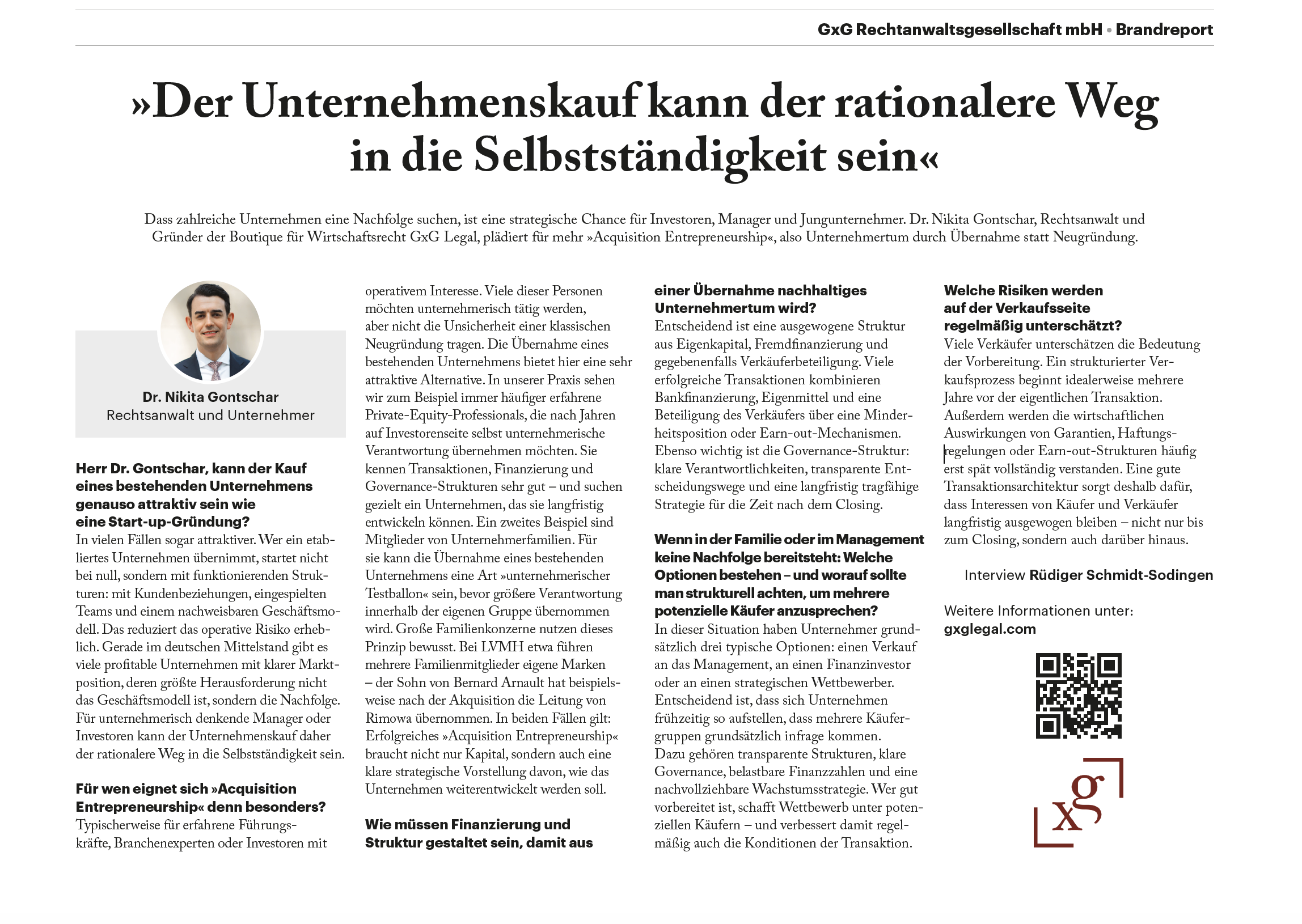
Interview in special supplement on M&A and succession in Handelsblatt dated March 25, 2026
In the interview, Dr. Nikita Gontschar explains why acquiring an established company is, in many cases, the more rational path to self-employment.